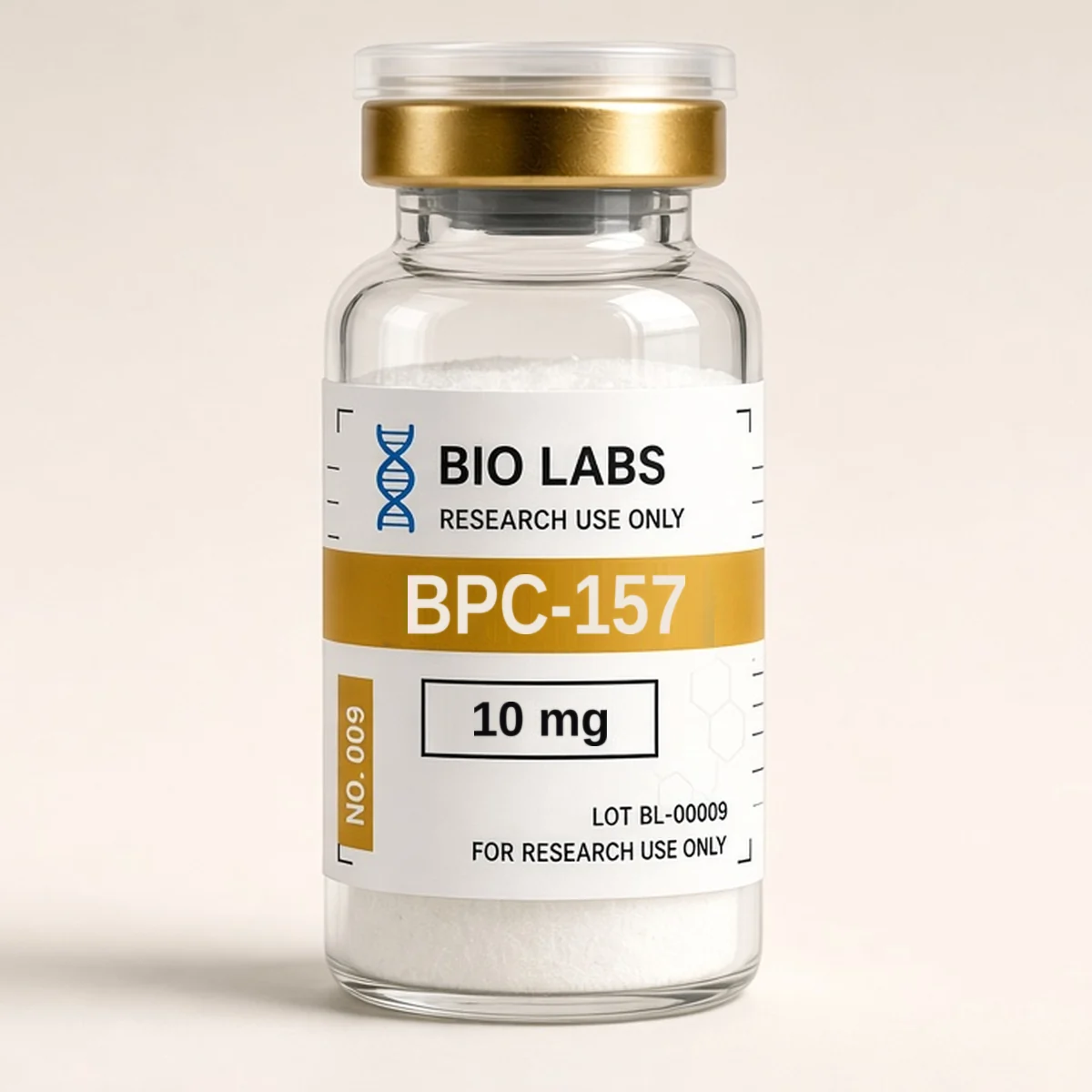
BPC-157 Research-Grade Peptide (Lyophilized, 10 mg / 20 mg)
Pentadecapeptide studied for cell-signaling models and vascular-signaling markers in laboratory systems. BPC-157 is for sale in 10mg and 20mg lyophilized vials.
Free FedEx delivery on orders $85+, otherwise $18.99.
Lyophilized 10 mg or 20 mg vial. Lab COA available.
Safety Data Sheet (SDS) · PDFShips to the contiguous US only
- CAS
- 137525-51-0
- Formula
- C62H98N16O22
- MW
- ~1419.5 Da
- Identity
- GEPPPGKPADDAGLV
Customer reviews
“I enjoyed products.”
Yaniv N. · October 2026
BPC-157: identity questions
What is BPC-157?
BPC-157 is a synthetic 15-residue peptide with the sequence Gly-Glu-Pro-Pro-Pro-Gly-Lys-Pro-Ala-Asp-Asp-Ala-Gly-Leu-Val (GEPPPGKPADDAGLV), CAS 137525-51-0, formula C62H98N16O22 and a molecular weight of about 1419.5 g/mol (PubChem CID 9941957). Its sequence is a fragment of a larger protein, named BPC, that was first isolated from gastric juice (Sikirić et al., 1993). For background, see what are peptides?.
What does the published research on BPC-157 describe?
Examples in the published literature include the isolation of BPC from gastric juice (Sikirić et al., 1993), a cell-culture study of growth hormone receptor expression in rat tendon fibroblasts (Chang et al., 2014) and a study of nitric oxide signaling in isolated rat aorta (Hsieh et al., 2020). A lab COA is available; where provided on the lot COA, it shows HPLC area percent at a stated wavelength and MS identity. See the COA library.
Multi-vial, lab or institutional order? Get a written quote within one business day.
Catalog questions
What does "research grade" mean for this BPC-157 listing?
Identity is the public sequence GEPPPGKPADDAGLV (CAS 137525-51-0, C62H98N16O22, ~1419.5 Da). Purity is not a slogan on this page. It is reported per lot on the COA.
How do I get the BPC-157 COA?
A lab Certificate of Analysis is available. Use "Request lot docs" on this page and enter the lot number from the vial label. We reply to your work email within one business day. Certificates that are hosted are listed in the COA Library.
What should a lot COA show?
The lot number, laboratory name and test date and, where provided on the lot COA, HPLC area percent at a stated wavelength (purity) and mass-spectrometry observed vs theoretical mass (identity). See how to read a peptide COA.
How is the material supplied and stored?
As a sealed lyophilized solid in a labeled vial. Lot-specific storage notes are on the SDS, available on request. The lot number on the vial matches the lot on the COA for traceability.
How do I buy BPC-157 for research, or order in quantity?
Order 10 mg or 20 mg vials online. Orders ship within the contiguous US and DC by FedEx, free on orders $85+. For multi-vial or institutional orders, use Request a Quote for a written quote within one business day.
Lot documentation
A lab certificate of analysis (COA) for BPC-157 is available. A certificate is the record for one lot, and it should name the laboratory that ran the analysis, the report date and the single lot it covers.
How a researcher can check the laboratory named on a certificate:
- Accreditation standard. ISO/IEC 17025 is the international standard for the competence of testing and calibration laboratories [1].
- Accreditation body. Accreditation bodies that recognize each other's accreditations are listed as ILAC MRA signatories [2]. Look the laboratory up in the public directory of the accreditation body the certificate cites.
- Scope. Accreditation covers a defined list of methods. Confirm that the scope includes the methods reported for the lot, such as HPLC and mass spectrometry [1].
A certificate covers only the lot printed on it. For a fuller supplier checklist, see how to verify a peptide supplier.
How do I check a BPC-157 lot COA?
A lab COA is available. To check the laboratory named on a certificate, look it up in the public directory of the accreditation body it cites, confirm the accreditation is to ISO/IEC 17025, and confirm that its scope covers the methods reported, such as HPLC and mass spectrometry. A certificate applies only to the lot printed on it.
COA per batch
One lot, one certificate. A BPC-157 Certificate of Analysis is valid only for the lot number printed on it. The lot number on the certificate must match the lot on the vial label and the packing slip.
A BPC-157 lot certificate names the laboratory and the test date and, where provided on the lot COA, shows:
- Identity by mass spectrometry: observed vs theoretical mass for BPC-157. The public record lists the sequence GEPPPGKPADDAGLV, formula C62H98N16O22 and molecular weight 1419.5 g/mol (PubChem CID 9941957, CAS 137525-51-0) [3].
- Purity as HPLC area percent at a stated detection wavelength (see below).
To get the certificate for your lot, use "Request lot docs" on this page with the lot number from your vial. Certificates hosted as real PDFs are listed in our COA library. A percentage without a lot number, a method and a laboratory behind it is not a lot record. Here's why a purity figure without a lot is not a record.
HPLC purity
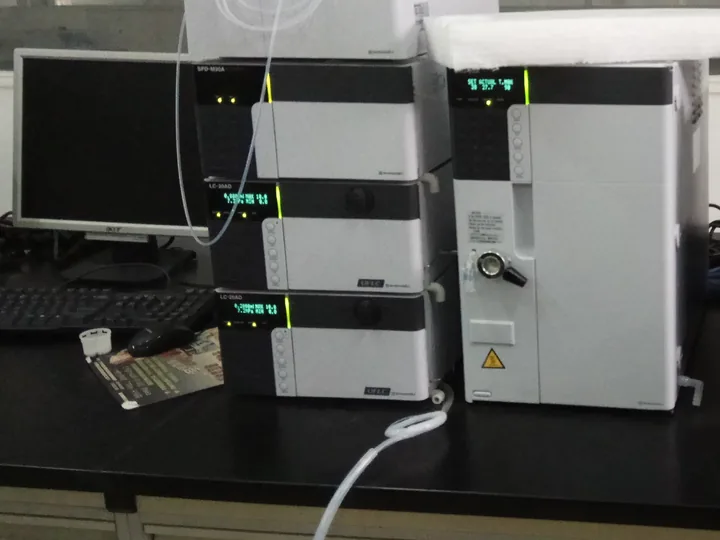
Where a BPC-157 lot certificate reports purity, it is given as HPLC area percent: the main peak's share of the total integrated UV peak area at the stated detection wavelength. Reversed-phase HPLC is the most widely used mode for peptide analysis and purification [4].
A purity figure is only readable with its method details:
- Method ID, column, mobile phase and gradient, and the detection wavelength.
- The chromatogram, with integrated peaks, not only a headline number.
- System suitability. The harmonized pharmacopeial chapter on chromatography defines resolution, signal-to-noise ratio and peak symmetry, which are the terms used to show the system was fit for the run [5]. Validation of analytical procedures is covered by ICH Q2(R2) [6].
What HPLC area percent does not tell you:
- Identity. Mass spectrometry confirms that the main peak is BPC-157 [3].
- Net peptide content. Water and counter-ions such as trifluoroacetate, which can come from solid-phase synthesis and purification, don't appear as UV peaks [7]. See HPLC area percent vs net peptide content.
Typical process-related impurities in synthetic peptides include deletion and insertion sequences, diastereomers from racemization, side-chain protection adducts and oxidation products [7]. A good chromatogram shows them as separate peaks.
We don't print a headline purity percentage on this page. Where provided, the figure for a lot is on that lot's certificate.
What does HPLC purity mean on a BPC-157 COA?
It is HPLC area percent: the main peak's share of the total integrated UV peak area at the stated detection wavelength. It is a relative purity figure for that lot and method. It does not confirm identity, which mass spectrometry does, and it is not net peptide content, because water and counter-ions do not appear as UV peaks.
References (for the sections above)
- ISO/IEC 17025:2017. General requirements for the competence of testing and calibration laboratories. https://www.iso.org/standard/66912.html
- ILAC. ILAC MRA and signatories. https://ilac.org/ilac-mra-and-signatories/
- National Center for Biotechnology Information. PubChem Compound Summary for CID 9941957, BPC-157. https://pubchem.ncbi.nlm.nih.gov/compound/9941957
- Mant CT, Chen Y, Yan Z, et al. HPLC analysis and purification of peptides. Methods Mol Biol. 2007;386:3–55. doi:10.1007/978-1-59745-430-8_1. https://pubmed.ncbi.nlm.nih.gov/18604941/
- United States Pharmacopeia. 〈621〉 Chromatography, harmonized standard (PDG Stage 4, official 1 Dec 2022). https://www.usp.org/harmonization-standards/pdg/excipients/chromatography
- ICH. Q2(R2) Validation of analytical procedures (2023). https://database.ich.org/sites/default/files/ICH_Q2%28R2%29_Guideline_2023_1130.pdf
- D'Hondt M, Bracke N, Taevernier L, et al. Related impurities in peptide medicines. J Pharm Biomed Anal. 2014;101:2–30. doi:10.1016/j.jpba.2014.06.012. https://pubmed.ncbi.nlm.nih.gov/25044089/


