
By BioLabs Research · Last reviewed: October 8, 2026
A catalog line that says “98% pure” is not a mass of peptide. On a reversed-phase HPLC trace, that number is almost always area percent: the main peak’s share of the UV-absorbing area under one method, at one wavelength. Water, acetate or trifluoroacetate (TFA) counter-ions, and residual solvent do not show up in that ratio. They still sit in the lyophilized cake.
Labs that treat area% as a weighing factor systematically mis-make solutions. This note is about how to read the three orthogonal measurements that actually belong on a lot document: chromatographic purity, mass identity, and net peptide content. It is written for laboratory purchasing and QC. It is not a dosing guide and not a claim about any catalog percentage on this site. Percentages below are literature examples, not BioLabs lot results.
What HPLC area percent actually measures
Reversed-phase HPLC with UV detection (commonly ~214–220 nm, where the peptide bond absorbs) integrates peaks. Area% for the main peak is:
main-peak area ÷ total integrated peptidic area, under that gradient, column, and detector setting.
It answers: of the UV-active peptidic material that eluted, how much is the intended peak? It does not answer: how many milligrams of that sequence are in this vial.
The method is also not identity. Deletion sequences, diastereomers, and incomplete-deprotection products from solid-phase peptide synthesis can co-elute or appear as shoulders. D’Hondt and colleagues reviewed those related-impurity classes — starting-material, process (deletion/insertion, epimerization, leftover protecting groups), and degradation (oxidation, deamidation, aspartimide, pyroglutamate) — in synthetic peptide materials.1 A single area% without the chromatogram, wavelength, and method is not a specification you can reproduce.
What mass spectrometry is for
Mass spectrometry asks a different question: does the observed mass match the theoretical mass of the named sequence (and salt form, if stated)? Intact MS is identity, not purity. A correct mass with a dirty chromatogram is still a mixed sample. A pretty chromatogram with the wrong mass is the wrong molecule.
A usable COA line for identity reports theoretical mass, observed mass, and the ionization method. Agreement is typically discussed in daltons or ppm, not as a second “purity %.” Sequence-level MS/MS is stronger still; most research-reagent COAs stop at intact mass. That limit should be read as a limit, not padded.
Independent work on commercially sourced research peptides has shown that labeled identity and measured identity are not automatically the same thing. Verbeke et al. evaluated synthetic peptides sold for R&D and documented quality failures that HPLC-alone paperwork would not have caught.2 Orthogonal MS is the cheap check against a mislabeled vial.
Net peptide content: the mass the HPLC never sees
Lyophilized peptide is a cake of peptide plus counter-ions plus water plus leftover solvent. TFA from RP-HPLC purification pairs with basic residues (Lys, Arg, His, and the N-terminus). That TFA is real mass. It is not the sequence.
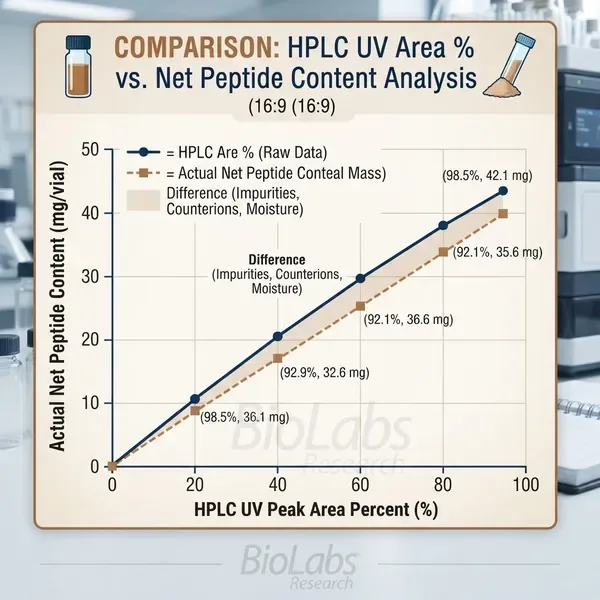
Net peptide content (NPC) is the peptidic mass fraction of the powder, usually from amino-acid analysis after hydrolysis or from nitrogen analysis, often with a separate moisture (Karl Fischer) figure. HPLC area% and NPC can both be “high” and still disagree, because they are not the same measurement. A TFA salt of a short, basic peptide can look >98% by area% and still be well below that by mass of sequence. That gap is expected chemistry, not a scandal, provided it is reported.
If a buyer needs a molar solution, the weighing arithmetic is:
sequence mass ≈ gross mass × NPC × HPLC area fraction
then divide by molecular weight. Skipping NPC is how a “10 mg” label becomes an unknown concentration. We will not print a house HPLC% or NPC% here. Ask for the lot docs.
| Measurement | Question it answers | Blind spot |
|---|---|---|
| HPLC area% | Share of UV-active peptidic peaks that is the main peak, under one method | Water, salts, TFA/acetate; co-elution; not identity |
| Intact MS | Does observed mass match the named sequence? | Not a purity percentage |
| Net peptide content | What fraction of the powder mass is peptide at all? | Does not by itself prove which peptide |
| CAS / sequence on the label | Public chemical identity of the listing | Not a lot certificate |
What to demand in lot docs
- Lot number that matches the vial label.
- HPLC: wavelength, column/gradient identifier or method ID, chromatogram or a statement that it is available, area% for the main peak.
- MS: theoretical mass, observed mass, method.
- NPC and/or counter-ion and moisture, if the work is quantitative.
- Testing lab named. “In-house, 99%” with no method is not a COA.
Residual solvents, when reported, belong against a named method (for example ICH Q3C classes), not a marketing adjective.3 Endotoxin is a separate assay for materials going into cell work; it is not implied by HPLC.
This site’s longer lab note on how we read a lot is How a Serious Lot Is Read. The walkthrough of a COA page is the COA guide.
What this site will not print
Product pages here do not carry an invented HPLC percentage. If a lot document exists, it is issued against that lot. If it does not, the honest line is “COA on request,” not a stock photo of someone else’s trace. CAS numbers on a science card are literature identifiers. They are not a substitute for observed mass on the COA.

In science, the answers are only as good as the questions we ask.
Catalog, then the lot paper
Listings are RUO reagents. Identity is the sequence and the COA, not a homepage badge.
Related notes
- Lot docs, not a purity percentage
- Peptide Purity and COA Explained
- Sourcing Research Compounds: A 2026 Guide
References
- D’Hondt M, Bracke N, Taevernier L, Gevaert B, Verbeke F, Wynendaele E, De Spiegeleer B. Related impurities in peptide medicines. J Pharm Biomed Anal. 2014;101:2–30. https://doi.org/10.1016/j.jpba.2014.06.012
- Verbeke F, Wynendaele E, Braet S, D’Hondt M, De Spiegeleer B. Quality evaluation of synthetic quorum sensing peptides used in R&D. J Pharm Anal. 2015;5(3):169–181. https://doi.org/10.1016/j.jpha.2014.12.002
- ICH. Impurities: Guideline for Residual Solvents Q3C. Current step 4 version. https://www.ich.org/page/quality-guidelines
Research use only. Not for human consumption, self-administration, or therapeutic use. Laboratory reagent listing only.