
By BioLabs Research · Last reviewed: October 15, 2026
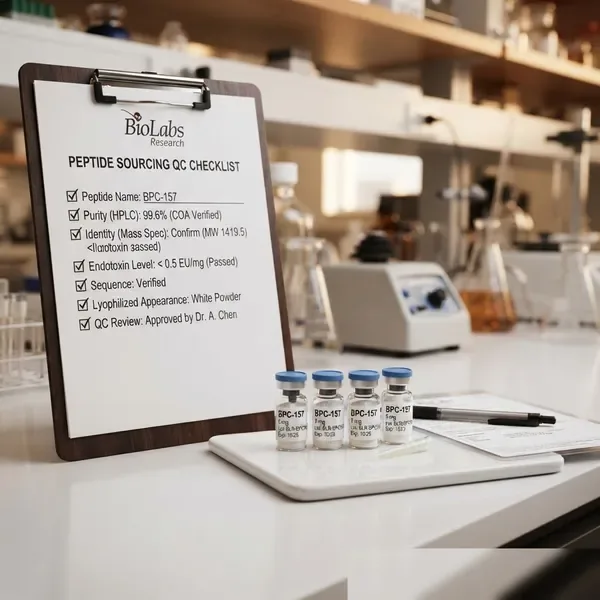
Laboratories inquire about research compounds from many desks. Quality of lot paper varies more than the shop name on the carton. This 2026 note is a receiving checklist — COA fields, RUO labeling, and a verifiable seller — not a coupon page and not a shopping script.
What this catalog lists
The primary term on this site is research compounds: RUO reagents for in vitro and laboratory work — not medicines, not supplements, and not for human consumption. Many listed items are peptides (short amino-acid chains). NAD+ is a coenzyme, not a peptide. Common names on this catalog include BPC-157, TB-500, NAD+, GHK-Cu, and Epithalon. A literature name is not automatically a SKU.

Key factors when choosing a supplier
1. Certificate of Analysis (COA) Availability
Lot paperwork is central. A careful supplier provides lot-specific COAs with HPLC purity and mass spectrometry data when those methods apply. If a supplier cannot provide a COA for the lot, ask why before proceeding. See our COA guide for what to look for.
2. Purity Standards
Research-grade lots should be accompanied by HPLC purity data on the lot docs. A specific percentage without a lot, method, and wavelength is not a meaningful claim.
3. Transparent Pricing
Pricing should be clearly listed and in a major currency (USD, EUR, GBP). Avoid suppliers with opaque pricing or who require you to "contact for a quote" on standard catalog items.
4. RUO Compliance
A legitimate research-compound supplier will prominently display RUO (Research Use Only) labeling and will not make therapeutic, clinical, or lifestyle claims about their products. This is both a regulatory and ethical standard.
5. Company Transparency
The supplier's company name, registered address, and contact information should be clearly visible on the website. Anonymous suppliers with no verifiable business entity are a risk.
6. Secure Inquiry Process
For RUO reagents, many suppliers use an inquiry-based checkout rather than direct payment processing. This is standard for research chemicals. Ensure the inquiry form is secure and that the supplier responds promptly.
Red flags when sourcing online
- Therapeutic claims — any supplier claiming their reagents "treat," "cure," or "heal" is violating RUO standards and likely cutting corners elsewhere
- No COA available — if the supplier cannot provide lot documentation, you cannot verify what is in the vial
- Crypto-only payments — while some legitimate suppliers accept crypto, a supplier that accepts only cryptocurrency with no other payment method is a red flag
- No company information — no registered business name, no address, no contact details
- Unrealistically low prices — significantly below market rate may indicate mislabeled or impure product
- No RUO labeling — listing research compounds without RUO designation suggests the supplier is marketing to consumers, not researchers
How to evaluate a supplier: checklist
- ☐ COA available on request or on website
- ☐ HPLC purity reported on lot docs
- ☐ Mass spectrometry data on COA
- ☐ Company name and address visible
- ☐ RUO labeling prominently displayed
- ☐ No therapeutic or lifestyle claims
- ☐ Clear pricing in a major currency
- ☐ Lot numbers on product labels
- ☐ Responsive customer service (test with a question)
- ☐ Secure checkout or inquiry process
Common research compounds in 2026
Based on current research literature, the following catalog names are commonly inquired for laboratory study:
- BPC-157 — gastric-derived pentadecapeptide studied in cell-migration models
- TB-500 — Thymosin Beta-4 fragment studied in cellular signaling
- NAD+ — nicotinamide adenine dinucleotide for biochemical reference studies
- GHK-Cu — copper-binding tripeptide studied in ECM and cellular-structure models
- G3-R — triple receptor agonist studied in metabolic research
- Epithalon — tetrapeptide studied in telomere / pineal pathway models
Trust, but verify. — Russian proverb
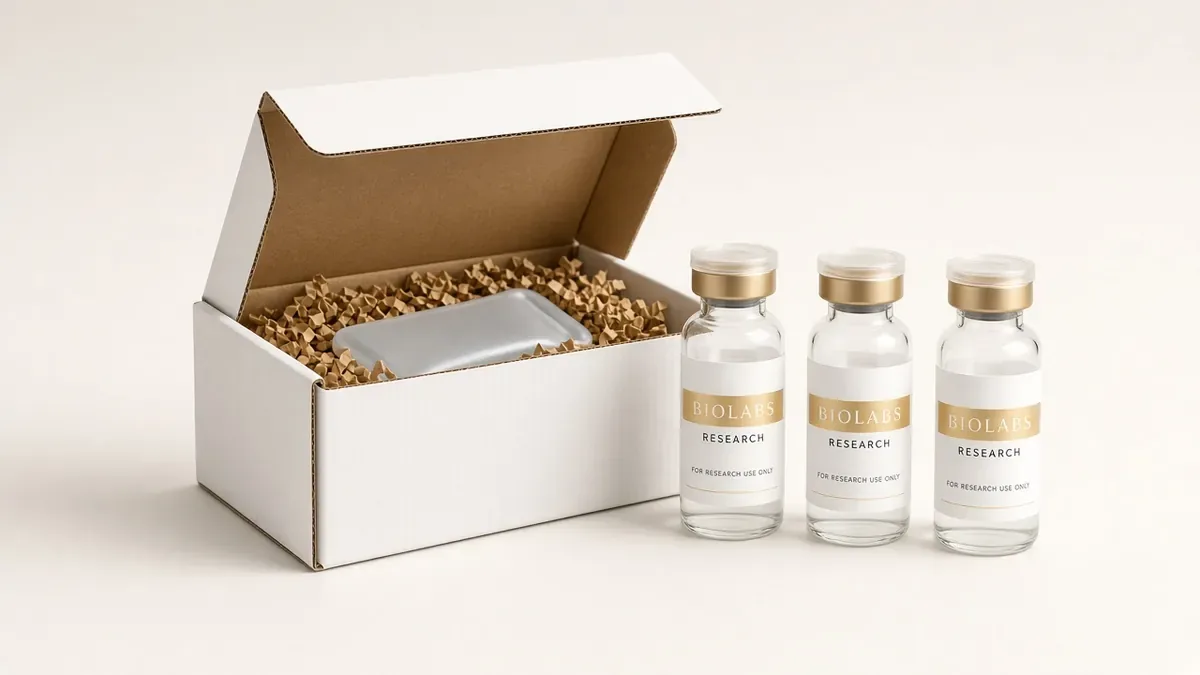
Keep each figure tied to a distinct receiving check: label identity, lot paper, and — when applicable — pack presentation. Adjacent screenshots without intervening notes make audits harder to reconstruct.
Research use only. Match the certificate fields to the physical lot before the material is booked into inventory or shared across sites.
Browse research compounds
All available SKUs. Lot docs on request. Research use only.
Related notes
Shipping and Handling Considerations
Lyophilized research compounds are typically packed as powder, which is stable at room temperature for short periods. For long-term storage, -20°C is recommended. When you inquire, consider:
- Shipping time — lots should arrive within a reasonable timeframe
- Packaging — sealed vials with desiccant are standard
- Tracking — always use tracked shipping for research reagents
See our shipping policy for details.
References
- PubChem for CAS/CID verification when vetting supplier paperwork. https://pubchem.ncbi.nlm.nih.gov/
Research use only. Not for human consumption, self-administration, or therapeutic use. Laboratory reagent listing only.