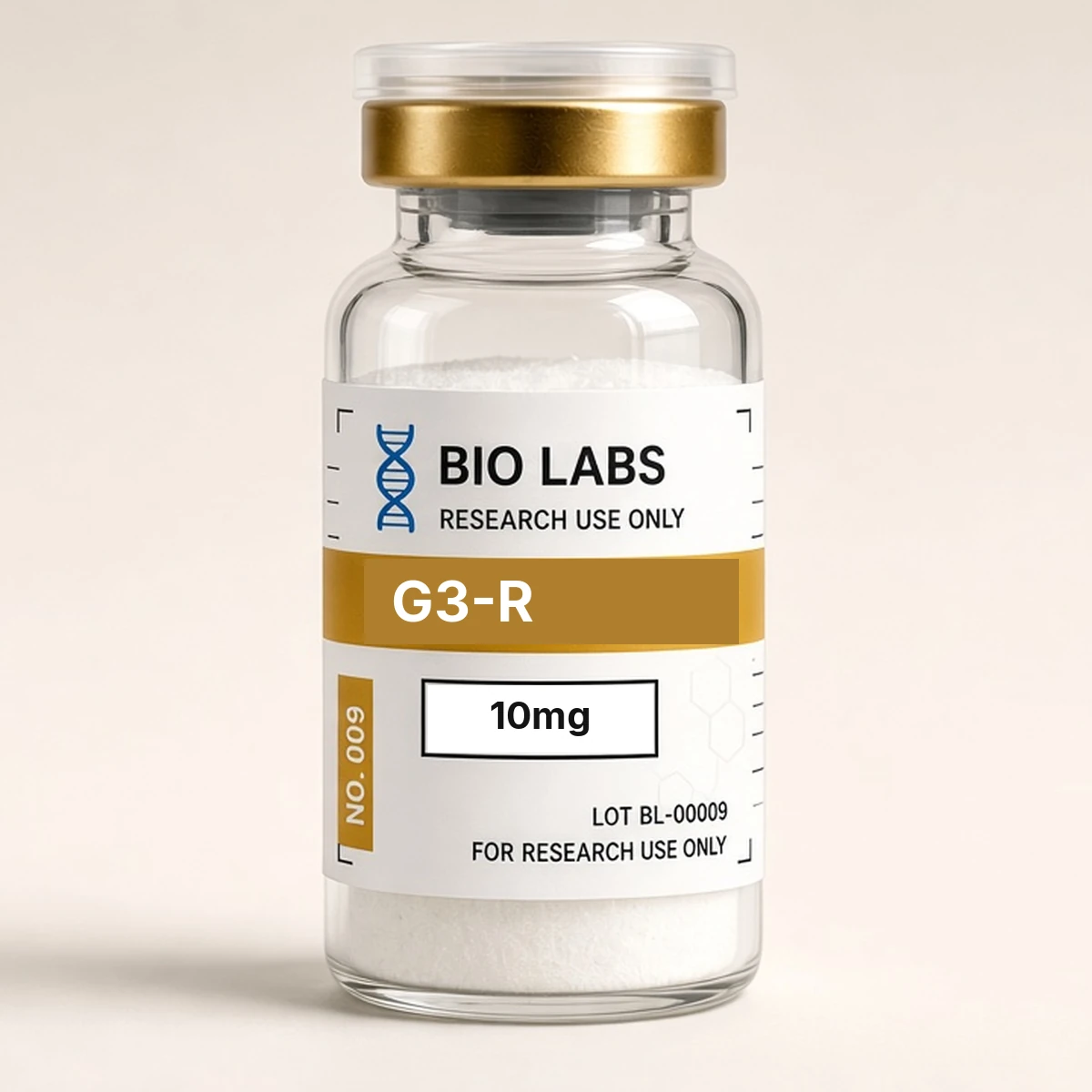
G3-R
G3-R is a lyophilized laboratory research peptide. Research use only, not for human use.
FedEx 2-Day, free over $200, otherwise $18.99.
Pay by card or crypto at checkout. Research use only.
Safety Data Sheet (SDS) · PDFShips to the contiguous US only
- Docs
- Lot papers on request
- Identity
- Lyophilized research peptide (RUO)
Research Literature
G3-R is supplied as a lyophilized laboratory research peptide for catalog identity and analytical work. Published method literature describes HPLC purity reporting, mass-spectrometric characterization, and lyophilized-peptide handling in laboratory settings. The PubMed links below are literature pointers only — not protocols, not medical advice, and not dosing guidance. Research use only.
- PMID 22982757 — Reversed-phase HPLC approaches used in synthetic peptide purity reporting (methods paper).
- PMID 22098412 — Mass-spectrometric characterization workflows for peptide research reagents.
- PMID 16691549 — Lyophilized peptide reagent handling and stability considerations in laboratory settings.
- PMID 26773890 — Analytical identity checks commonly cited for lyophilized research peptides.
Lot truth remains on the matching COA. Policy boundary: Zero-Tolerance.
Multi-vial, lab or institutional order? Get a written quote within one business day.
Catalog questions
What research applications is G3-R studied for?
G3-R is supplied for in-vitro work and laboratory models only. Researchers who use it typically design their studies from the published literature and use the catalog material as an analytical reference material, matched to a lot-specific Certificate of Analysis. BIO LABS Research does not describe, predict or claim any outcome for G3-R in any system. The product page lists only catalog identity, lot documentation, storage and ordering. Study design, methods and interpretation remain the responsibility of the qualified laboratory, based on the primary published sources.
Is G3-R FDA approved?
No. G3-R is not approved by the FDA or any other regulator, and BIO LABS Research makes no regulatory or clinical claim for it. It is sold strictly as a research-use-only (RUO) material for in-vitro and laboratory research. It is not for human or veterinary use, and it is not a medicine or a consumer product. Visitors confirm research-only use at the site entry gate, and orders that conflict with that use may be cancelled under our Zero-Tolerance policy.
What purity documentation comes with G3-R?
Every vial carries a lot number on its label. A lot-specific Certificate of Analysis is available on request: use the batch COA request form on the product page or the COA page, and give the catalog code G3-R plus the lot number. Where provided on the lot COA, purity is reported as HPLC area percent at a stated wavelength, with mass-spectrometry identity, the laboratory name and the test date. No purity figure is published on the product page without a lot behind it.
How should G3-R be stored in the lab?
G3-R is supplied as a sealed lyophilized solid. General laboratory practice for lyophilized peptides is to keep the vial sealed and frozen at about -20 °C for longer holding, protected from light, and dry. Let a cold vial reach room temperature before opening, so moisture does not condense on the solid. Avoid repeated temperature cycling. Lot-specific storage conditions and any stability statement come from the SDS for that lot, which is available on request and takes priority over this general note.
What is the difference between G3-R, G2-T and G1-S?
G1-S, G2-T and G3-R are three separate catalog codes. Each code has its own label, its own lot numbers and its own Certificate of Analysis. They are not grades, strengths or versions of one material, and the catalog does not rank them against each other. When a vial arrives, match the code on the carton and invoice, then match the lot number on the vial to the lot on the COA. G1-S and G3-R are active listings; G2-T is not currently listed. Request any lot COA from the COA page. G1-S / G2-T / G3-R catalog codes


