An immobilized thiol catalyst moves native chemical ligation into continuous flow
A JACS Au study published October 17, 2026 describes native chemical ligation run in continuous flow with an immobilized thiol catalyst, compatible with inline desulfurization, for synthetic peptides up to 84 amino acids long.
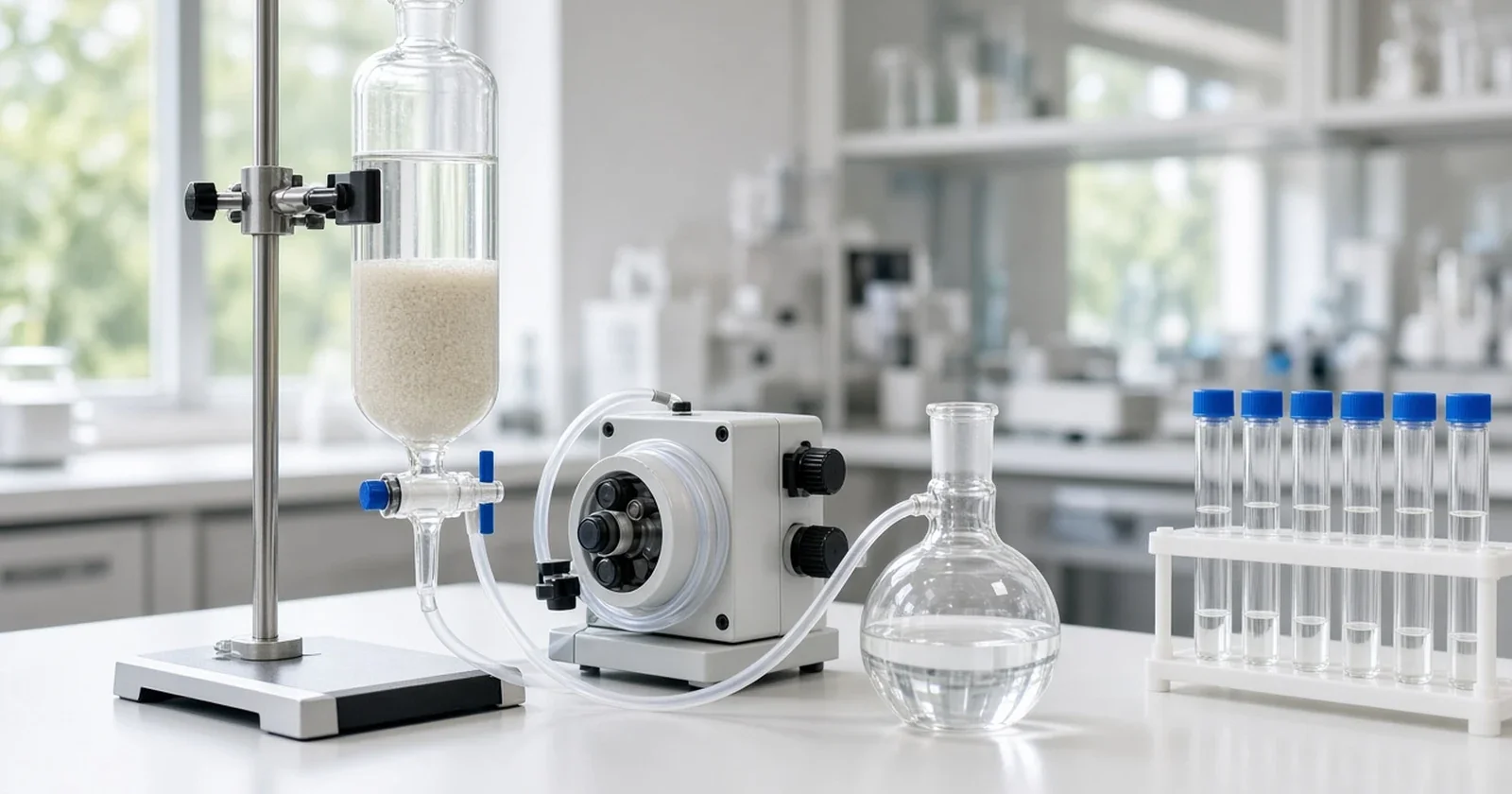
Researchers from the University of Copenhagen and two pharmaceutical-industry companies have reported a continuous-flow version of native chemical ligation (NCL), a reaction chemists use to join unprotected peptide segments into longer chains. The study, "Immobilized Thiol Catalysts for Native Chemical Ligation in Flow," was published in JACS Au on October 17, 2026, under an open-access CC BY-NC-ND 4.0 license. [1] An earlier version was posted as a ChemRxiv preprint in July 2026. [2]
Why long peptides need ligation
Stepwise solid-phase peptide synthesis (SPPS) is the standard way to build peptides, but its practical length is limited. One review puts the ceiling at roughly 50 residues, pointing to aggregation, amino acid addition or deletion errors and side reactions that build up as the chain grows. [3]
NCL, developed in the Kent laboratory and described in Science in 1994, works around that limit by joining separately made segments in solution. [3][4] The reaction is selective: a peptide carrying a C-terminal thioester reacts with a partner that has an N-terminal cysteine, and a rearrangement then leaves a native peptide bond at the junction. [3] Because cysteine is relatively uncommon, ligation is often followed by desulfurization, which converts the cysteine at the ligation site to alanine. [3]
The catalyst problem
NCL is usually run with an added thiol. In a comparison of fourteen thiol catalysts, aryl thiols outperformed alkyl thiols, and 4-mercaptophenylacetic acid (MPAA) emerged as an efficient, water-soluble, non-malodorous option. [3]
The new paper's authors argue that dissolved, or homogeneous, thiol catalysts are part of what has kept NCL at research-laboratory scale. They can be incompatible with desulfurization methods and difficult to remove during later chromatographic purification. The authors also cite low volume yields and slow reaction kinetics as limits on wider use. [1]
What the team built
The group developed an immobilized version of MPAA, so the catalyst stays in place in the flow system instead of being dissolved in the reaction mixture. [1]
The process starts from peptide hydrazides, which the authors describe as shelf-stable. These are activated in situ to acyl pyrazoles, converted to reactive thioesters in flow by the immobilized catalyst, and then ligated with cysteine-containing peptides. [1] The hydrazide step builds on a 2018 method in which peptide hydrazides react with acetylacetone, a classic Knorr pyrazole reaction, to form acyl pyrazoles that exchange with an aryl thiol for use in NCL. [5]
According to the paper, the platform is directly compatible with inline desulfurization and supports high-throughput synthesis of complex, structurally diverse peptides up to 84 amino acids long. [1] The authors present the work as establishing immobilized aryl thiols as viable NCL catalysts in continuous flow. They also say it identifies the key challenges involved and lays a foundation for its use in industrial peptide manufacturing. [1] Reaction conditions, yields and the individual sequences made are reported in the full paper. [1]
Why it matters for analytical work
Every reagent added during a synthesis is something that purification and analysis later have to account for. Holding the thiol catalyst in place addresses one of the problems the authors name directly: removing a dissolved catalyst during chromatography. [1] For laboratories that work with long synthetic peptides as reference materials, it is a reminder of why lot-specific identity and purity data, typically from HPLC and mass spectrometry, matter.
Key points
- A JACS Au study published October 17, 2026 reports native chemical ligation run in continuous flow.
- An immobilized MPAA catalyst converts activated peptide hydrazides into reactive thioesters in flow.
- The platform is compatible with inline desulfurization and supports peptides up to 84 amino acids long.
Related: Chemists automate the azapeptide submonomer method · Reading a COA · Peptide Academy
All BioLabs Research products are sold strictly for laboratory research use only. Not for human or veterinary use. This article summarizes published research and makes no claims about any BioLabs product.
For research use only. Not for human or veterinary use. Not a drug, food, or cosmetic.
- Egelund P.H.G. et al., "Immobilized Thiol Catalysts for Native Chemical Ligation in Flow," JACS Au, published October 17, 2026, CC BY-NC-ND 4.0
- ChemRxiv preprint, "Immobilized Thiol Catalysts for Native Chemical Ligation in Flow," v3 posted July 13, 2026 (v2 July 9, 2026)
- Thapa P., Zhang R.-Y., Menon V., Bingham J.-P., "Native Chemical Ligation: A Boon to Peptide Chemistry," Molecules 2014;19:14461-14483
- Dawson P.E., Muir T.W., Clark-Lewis I., Kent S.B., "Synthesis of Proteins by Native Chemical Ligation," Science 1994;266:776-779
- Flood D.T. et al., "Leveraging the Knorr Pyrazole Synthesis for the Facile Generation of Thioester Surrogates for use in NCL," Angew. Chem. Int. Ed. 2018;57:11634-11639