Peptide Academy · Research use only
Lab detectives: how HPLC and mass spec prove what's in a vial
Peptide Academy · Chapter 5 of 7
Every vial of research material has to answer two questions:
- Is it the right thing? (identity)
- How much of it is the right thing? (purity)
Two lab techniques do most of that work for peptides: HPLC and mass spectrometry. You'll see both on a good certificate of analysis (Chapter 4). This chapter explains what each one actually does, in plain English.
Why testing matters at all
Making a peptide is a step-by-step process, and steps can go wrong. Most lab peptides are built by solid-phase peptide synthesis, adding one amino acid at a time [1]. A 2014 review of impurities in peptide medicines lists what can end up in the final powder [2]:
- Deletion sequences: a building block went missing somewhere in the chain.
- Insertion sequences: an extra block got added.
- Racemised residues: a building block flipped into its mirror-image form.
- Leftover protecting groups: chemical "caps" used during synthesis that weren't fully removed.
- Oxidised side chains, dimers (two chains stuck together) and breakdown products.
- Counter-ions such as trifluoroacetate, left over from purification.
The same review notes that impurities like these can distort early laboratory studies and lead to wrong conclusions [2]. Testing is how you find out what's really there.
HPLC: the race
HPLC stands for high-performance liquid chromatography. Here's the idea.
Picture a race on a track covered in sticky obstacles. Every runner is a different molecule. The sample is dissolved in liquid and pushed under pressure through a narrow tube, called a column, packed with tiny particles. Molecules that interact more with the particles slow down; others zip through. So different molecules leave the column at different times.
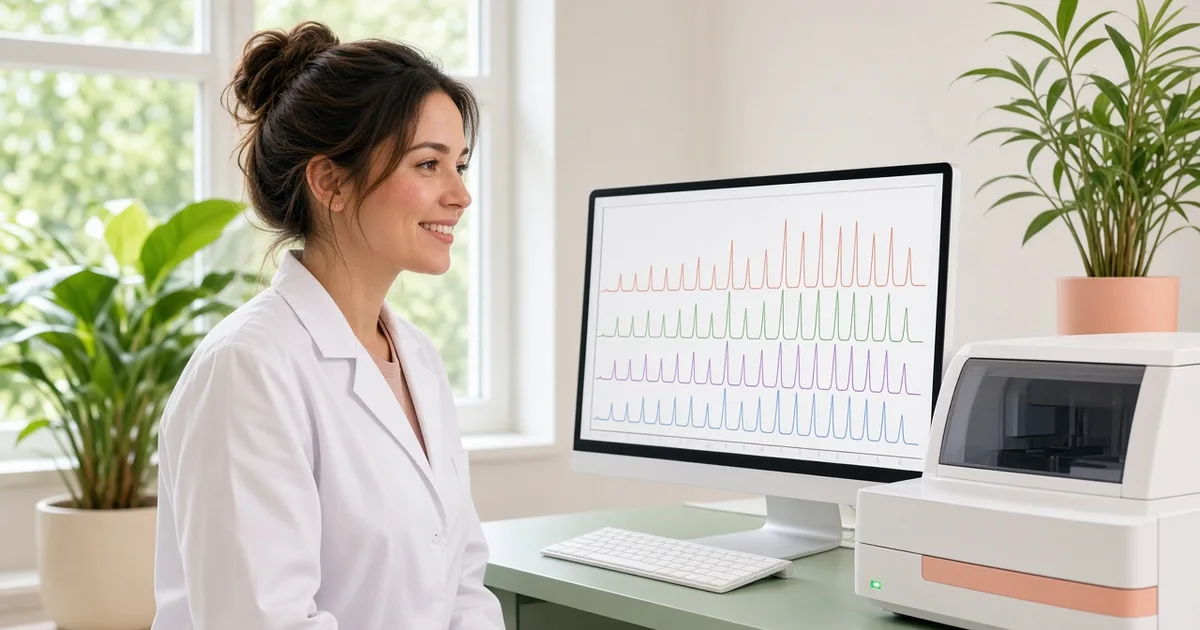
At the finish line sits a detector. Each time a group of molecules crosses it, the detector draws a bump, called a peak, on a chart called a chromatogram. The time each peak shows up is its retention time.
How to read the result:
- One big peak and very little else means most of the material is a single substance.
- Lots of smaller peaks means other substances are present.
Purity is usually reported as the main peak's share of the total peak area, under a stated method and detector setting. That's why a purity figure only really means something alongside its method and the chromatogram itself.
HPLC's blind spot
HPLC is great at telling you how clean a sample is. It's not built to tell you what the main peak is. A wrong peptide can still produce one tidy peak. To prove identity, you need a second test.
Mass spectrometry: the weigh-in
Mass spectrometry (MS) weighs molecules, very precisely.
Every peptide has an expected mass that can be calculated from its sequence, because each amino acid adds a known amount. The instrument turns molecules into charged particles, then measures their mass-to-charge ratio. The result is a mass spectrum: a chart of signals at specific values.
If the measured mass matches the expected mass for the sequence, that's strong evidence you have the right molecule. Think of it as a fingerprint check. If a building block is missing, the mass comes out lighter by roughly that block's weight; an extra block makes it heavier. That's how MS helps spot deletion and insertion sequences.
Better together: LC-MS
Labs often connect the two instruments, a set-up called LC-MS (liquid chromatography–mass spectrometry). The HPLC separates the sample into its parts, and the mass spectrometer weighs each part as it comes out. A 2012 study used this kind of approach to characterise the acetylated thymosin beta-4 fragment found in products sold as TB-500 [3].
The pairing is the whole point:
| Question | Test | Plain-English version |
|---|---|---|
| How pure is it? | HPLC | Who finished the race, and how big was each group? |
| Is it the right molecule? | Mass spectrometry | Does the winner weigh what it should? |
A certificate with only one of these answers only half the question.
What these tests don't tell you
It's worth being honest about limits:
- Neither test measures net peptide content directly. That's the share of the powder's weight that's peptide at all, as opposed to water and counter-ions (Chapter 4 explains the difference).
- A result applies to the lot that was tested. A certificate from another batch says nothing about your vial.
- Methods matter. Different columns, solvents and detector settings can give different-looking chromatograms for the same material. That's why the method should be stated.
- Testing tells you what's in the vial, not what it does. Analytical chemistry confirms identity and purity. It says nothing about biological effects.
Reading the charts on a COA
When you open a certificate, look for:
- The chromatogram: one dominant peak, with the purity calculation and method listed.
- The mass spectrum: a measured mass, plus the expected mass for comparison.
- The lot number, date and lab tying both results to one specific batch.
For a field-by-field walkthrough, see our guide on how to read lot documents. Lot COAs for our catalog, including BPC-157, TB-500 and GHK-Cu, are available on request.
Frequently asked questions
What is HPLC in simple terms? A separation test. The sample is pushed through a packed column, different molecules come out at different times, and a detector draws each one as a peak. The main peak's share of the total area is reported as purity.
What does mass spectrometry show? The mass of the molecules in a sample. If the measured mass matches the expected mass for a peptide's sequence, that supports its identity.
Why do you need both HPLC and mass spec? HPLC shows how clean a sample is but not what the main substance is. Mass spec confirms identity. Together they answer both questions.
What impurities can be found in synthetic peptides? A 2014 review lists deletion and insertion sequences, racemised residues, leftover protecting groups, oxidised side chains, dimers, counter-ions and breakdown products.
Series navigation: ← Chapter 4: How to read a COA · Hub · Next: Chapter 6: Basic terms →
For laboratory research use only. Not for human or veterinary use. Not a drug, food, cosmetic or dietary supplement.
References
- Merrifield RB. Solid phase peptide synthesis. I. J Am Chem Soc. 1963;85(14):2149–2154. doi:10.1021/ja00897a025
- D'Hondt M, Bracke N, Taevernier L, et al. Related impurities in peptide medicines. J Pharm Biomed Anal. 2014;101:2–30. doi:10.1016/j.jpba.2014.06.012. PMID 25044089
- Esposito S, Deventer K, Goeman J, Van der Eycken J, Van Eenoo P. Synthesis and characterization of the N-terminal acetylated 17-23 fragment of thymosin beta 4 identified in TB-500. Drug Test Anal. 2012;4(9):733–738. PMID 22962027