HDOCK-Multimer combines docking and combinatorial assembly to predict structures of large protein complexes
Researchers at Huazhong University of Science and Technology in Wuhan, China, reported in Nature Computational Science, published online on 14 October, HDOCK-Multimer (HDM), an open framework for predicting the three-dimensional structures of large protein assemblies.
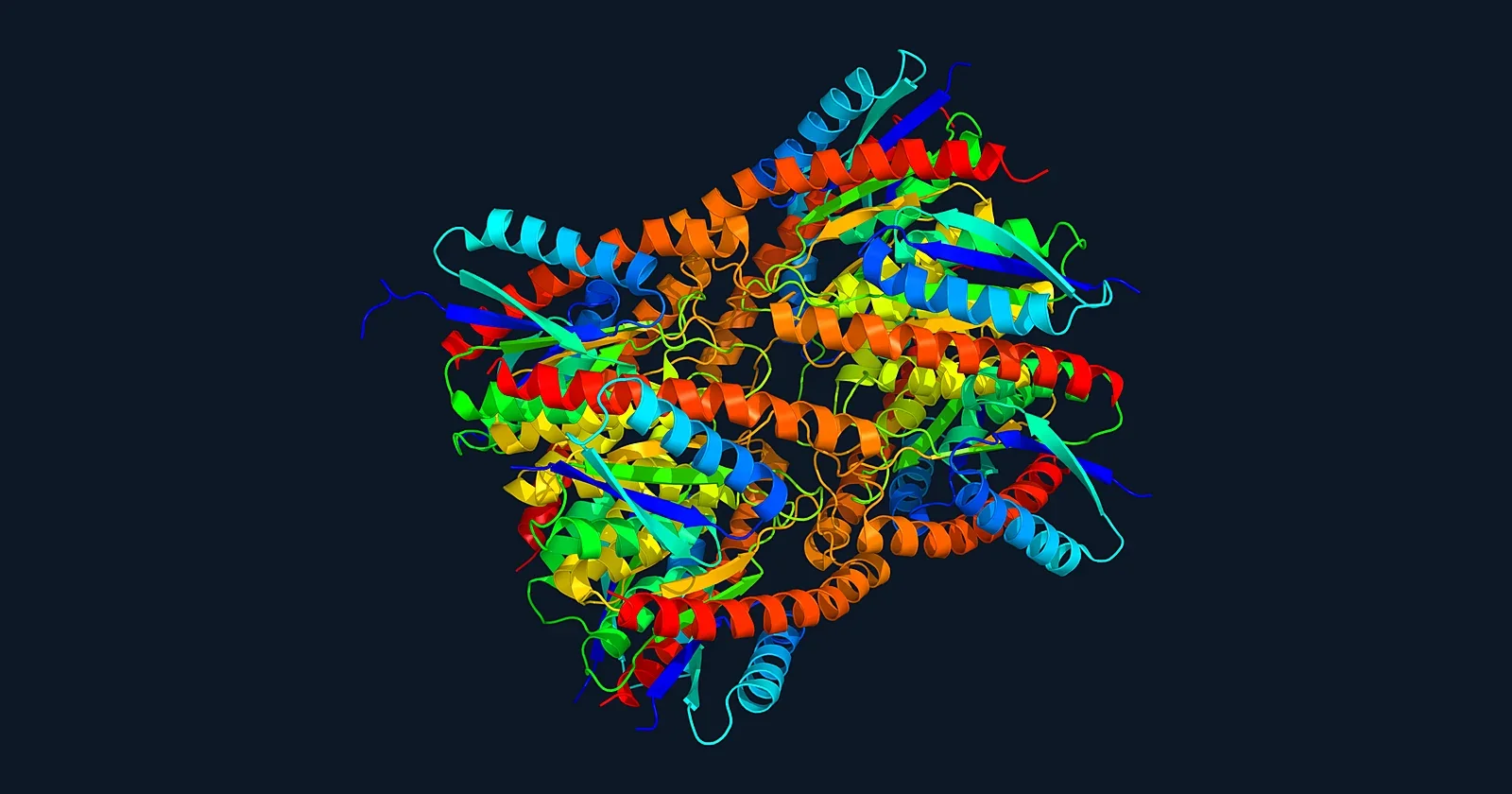
Summary. Researchers at Huazhong University of Science and Technology in Wuhan, China, reported in Nature Computational Science, published online on 14 October, HDOCK-Multimer (HDM), an open framework for predicting the three-dimensional structures of large protein assemblies. End-to-end deep-learning predictors struggle with very large multi-chain complexes because of their size, intricate chain interactions and graphics-memory limits, while pure docking faces a combinatorial explosion of possible chain arrangements. HDM starts from AlphaFold-predicted monomers and three-chain subcomponents, then chooses among asymmetric docking, symmetric docking for cyclic, dihedral, tetrahedral and octahedral assemblies, and a genetic-algorithm-guided combinatorial assembly, ranking the final models with the group's knowledge-based scoring function.
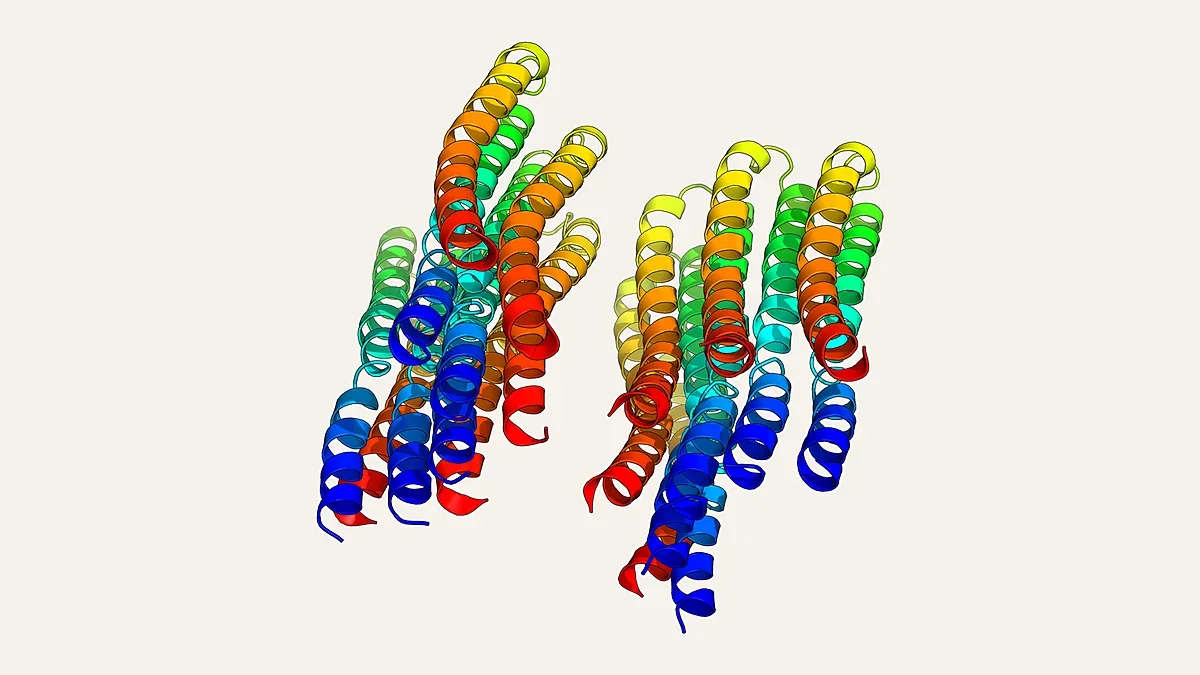
Research context (RUO). On a benchmark of 35 large heteromeric complexes with 5 to 20 chains, HDM produced an acceptable top-ranked model (TM-score above 0.7) for 83 percent of targets, compared with 74 percent for CombFold, 29 percent for MoLPC and 29 percent for AlphaFold-Multimer version 2. On 172 large complexes with 10 to 30 chains it reached 59 percent top-ranked success versus 55 percent for AlphaFold3, which could model only 145 of those targets because of input-size limits, and it produced acceptable models for 6 of 7 large CASP15 targets. The authors note that AlphaFold3 still builds more high-quality interfaces on many targets, that asymmetric complexes remain harder, and that stoichiometry normally has to be supplied, although the method can help narrow it down. HDM can also use crosslinking mass-spectrometry distance restraints. The code is freely available on GitHub and Zenodo, and the paper is open access. The study is computational structural biology with no clinical component. For structural-biology and proteomics laboratories, it offers a practical tool for modelling assemblies too large for current end-to-end predictors.