🔥🔥🔥
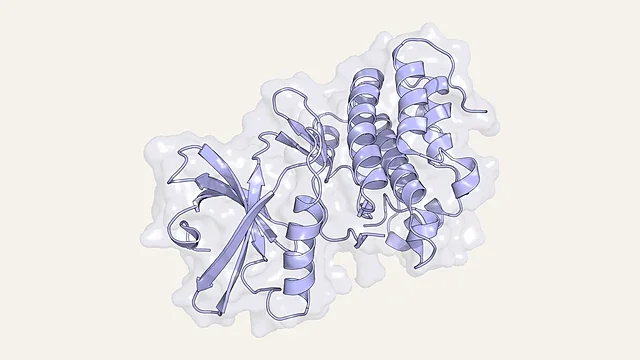
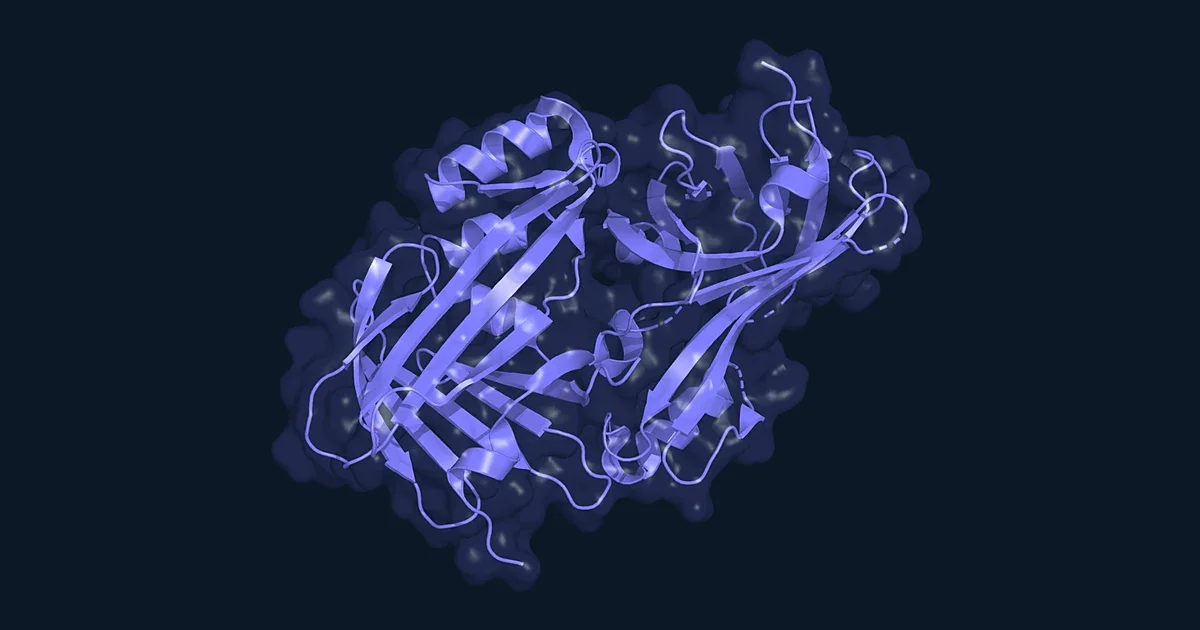
Photo: Image: BioLabs Research, rendered from PDB 1MRU (RCSB PDB, CC0) / own upload
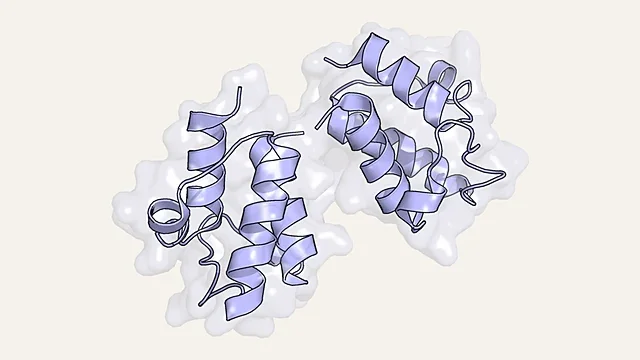
Researchers at Freie Universität Berlin reported in the Journal of Chemical Information and Modeling on 20 October a benchmark of four AI cofolding models, AlphaFold3, RoseTTAFold3, Boltz-2 and Chai-1, on kinase and Class A GPCR complexes released after the models' training cutoffs. Correct ligand placement was systematically decoupled from the surrounding protein conformation: state-defining features such as the kinase activation loop and GPCR intracellular regions were often mispredicted even when ligand RMSD was low, and confidence scores tracked ligand placement rather than pocket geometry. The study is a computational benchmark.
Read the Full Update
🔥🔥
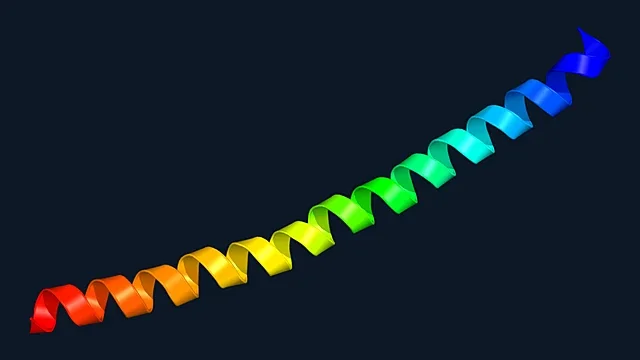
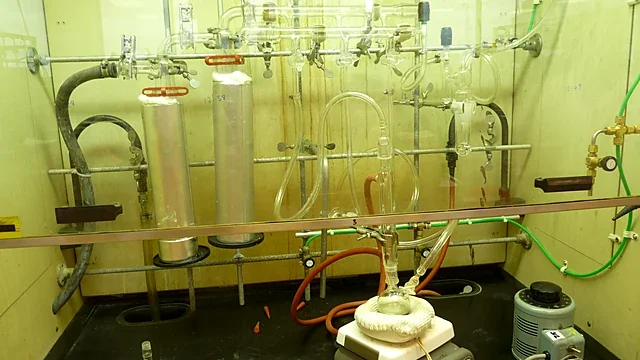
Photo: Image: BioLabs Research, rendered from PDB 1IFJ (RCSB PDB, CC0) / own upload
Researchers at Kansai University in Japan reported in the Journal of Peptide Science on 22 October a phage display screen against silver iodide, a classic artificial ice-nucleating agent. Of five selected sequences made by Fmoc solid-phase synthesis, three suppressed ice nucleation, with the seven-residue peptide SHIARSV the most active. An alanine scan then identified AHIARSV, which was more active than the original and also strongly inhibited ice recrystallization. The study is a peptide-chemistry and materials report.
Read the Full Update
🔥🔥
Chemically synthesized mini luciferase reveals a single methionine that oxidizes during its light reaction
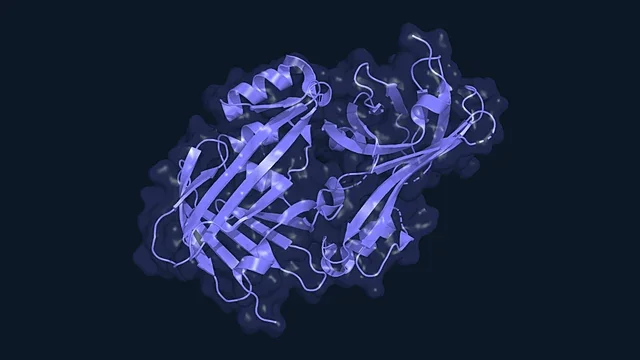
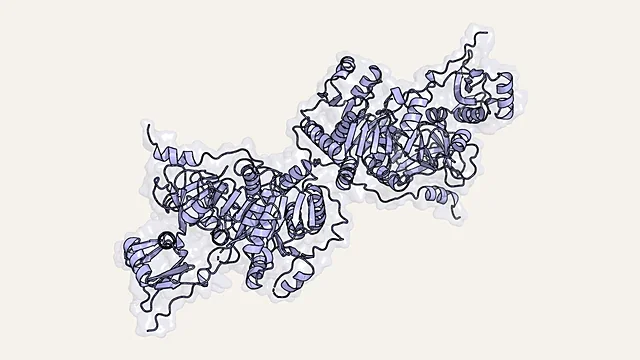
Photo: Image: BioLabs Research, rendered from PDB 5IBO (RCSB PDB, CC0) / own upload
Researchers at the Institute of Science Tokyo, Kyoto Pharmaceutical University and Shimadzu reported in Bioconjugate Chemistry on 22 October the total chemical synthesis of picALuc, a minimal artificial luciferase derived from copepod luciferases, by sequential native chemical ligations and oxidative refolding. During its bioluminescence reaction the protein unexpectedly gained one oxygen; variants carrying norleucine or methionine sulfoxide identified the site as Met82. The oxidation did not change the flash-type light kinetics, while the sulfoxide's position affected folding efficiency and hydrophilicity.
🔥
Metadynamics protocol scores which twist a self-assembling peptide nanofibril prefers
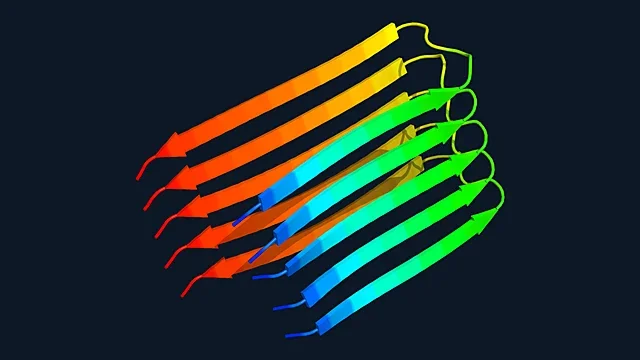
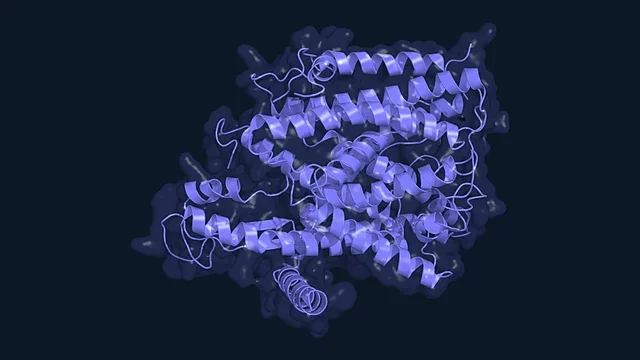
Photo: Image: BioLabs Research, rendered from PDB 2BEG (RCSB PDB, CC0) / own upload
Researchers at the University of Manchester reported in The Journal of Physical Chemistry B on 19 October an all-atom simulation protocol for cross-beta peptide nanofibrils that uses supramolecular twist as the metadynamics sampling coordinate, helping simulations escape local energy minima. From these runs they compute a "resistance score" for each fibril morphology, from ribbons to rods, and used it to study how fibril length and peptide sequence affect twist, comparing the results with electron-microscopy observations. The authors see it as a tool for designing new self-assembled peptide architectures.
🔥
Benchmark pairs four DIA search engines with four quantitation tools for label-free proteomics
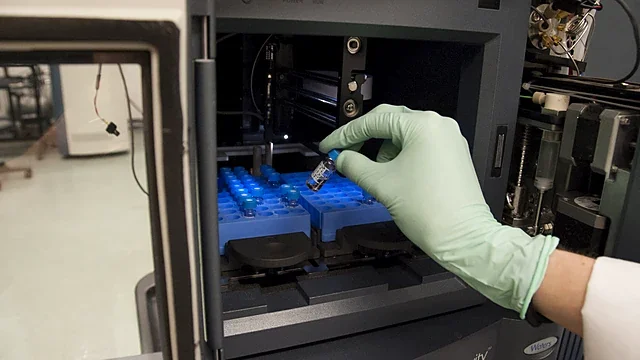
Photo: The U.S. Food and Drug Administration / Wikimedia Commons (Public domain) / own upload
Researchers at the Russian Academy of Sciences reported in the Journal of Proteome Research on 21 October a comparison of data-processing workflows for label-free data-independent acquisition (DIA) proteomics. They combined four search workflows (DIA-NN, DIA-Umpire, diaTracer and MSFragger-DIA) with four quantitation utilities (directLFQ, AlphaPeptStats, Triqler and a simple t test) and scored each pairing on protein identifications, differential-expression sensitivity, fold-change accuracy and quantitative false-discovery-rate control, using two spike-in benchmark datasets, ending with practical pipeline recommendations.
For research-community awareness only. Not legal advice.
🔥
PRIDE analysis of 159 million downloads separates bots from researchers reusing proteomics data
Photo: Derrick Coetzee from Berkeley, CA, USA / Wikimedia Commons (CC0) / own upload
Researchers at EMBL's European Bioinformatics Institute reported in PROTEOMICS on 21 October an analysis of 159.3 million download records from the PRIDE proteomics archive (2021 to 2025) covering 35,528 datasets. A Nextflow pipeline processes the logs, and a machine-learning framework called DeepLogBot, trained with consensus labels from two large language models, sorts traffic into bots, institutional download hubs and independent downloads, with 92.2% bot-classification accuracy on a held-out test set. Independent downloads came from 214 countries and regions, with the top five accounting for over 54%.
Curated for research-community awareness. Not medical or legal advice. All products on this site are for laboratory research use only.