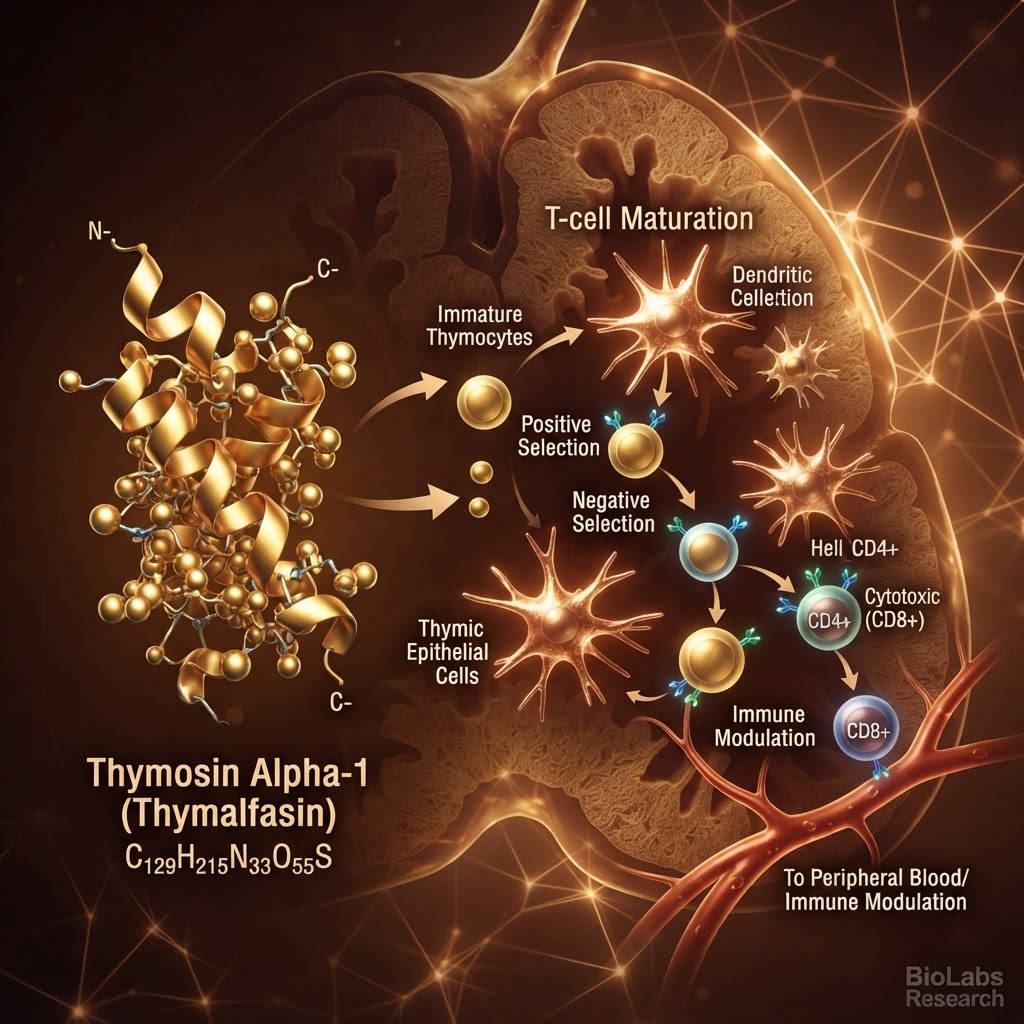
Thymosin Alpha-1 (Thymalfasin): a 28-amino acid peptide from thymic extract with
Thymosin alpha-1 is a 28-residue peptide with an N-acetyl serine: Ac-SDAAVDTSSEITTKDLKEKKEVVEEAEN. The international nonproprietary name is thymalfasin. It is chemically unrelated to thymosin beta-4 and to the catalog name TB-500. People mix the two thymosin words because both historically came out of thymus extracts. The sequences do not overlap as a purchasing identity.
This note is laboratory chemical identity. It does not sell hepatitis use, immune boosting, vaccine-adjuvant stories, or a branded injectable. The licensed medicinal product associated with this sequence in some markets is not this RUO listing.
The published 28-mer
Goldstein, Low, and colleagues isolated thymosin alpha-1 from calf thymus and reported a 28-residue sequence in 1977.1 PubChem indexes thymalfasin as CID 16130571 with formula C129H215N33O55, molecular weight 3108.3 g/mol, and CAS 62304-98-7.2 The biologic description on that record is N-acetyl-Ser at the N-terminus and the one-letter chain SDAAVDTSSEITTKDLKEKKEVVEEAEN.
| Field | Public listing |
|---|---|
| Common name | Thymosin alpha-1; Tα1 |
| INN | Thymalfasin |
| Sequence | Ac-SDAAVDTSSEITTKDLKEKKEVVEEAEN |
| Length | 28 amino acids, N-acetyl Ser |
| PubChem CID | 16130571 |
| CAS | 62304-98-7 |
| Formula (commonly listed) | C129H215N33O55 |
| MW | ~3108 Da (PubChem 3108.3 g/mol) |
| Not this listing | Thymosin β4; TB-500; intact prothymosin-α |
The acetyl group is identity. A 28-mer with a free N-terminal serine is a different mass. The COA must say N-acetyl (or Ac-Ser) in words and must match the theoretical mass to that statement.
Precursor context: prothymosin-alpha P06454
Human prothymosin-alpha is UniProt P06454 (PTMA). The reviewed entry annotates thymosin alpha-1 as a peptide spanning residues 2-29 of the precursor after removal of the initiator methionine, with N-acetylserine on the processed chain.3 That is precursor context: where the 28-mer sits in a human protein. It is not a claim that a synthetic RUO vial is isolated from human thymus, and it is not a claim that the vial is the full 111-residue prothymosin-alpha.
A lot labeled prothymosin or thymosin fraction 5 is a different material class — historically a mixture. Synthetic thymalfasin is a single 28-mer. Do not file a fraction-5 COA against this SKU.
Not TB-500, not thymosin beta-4
Thymosin beta-4 is a different polypeptide (a 43-residue actin-binding peptide in the native sequence). The catalog name TB-500 on this site is a fragment listing, commonly the N-acetyl LKKTETQ stretch, not intact T-beta-4. Neither of those molecules is Ac-SDAAVDTSSEITTKDLKEKKEVVEEAEN. Sharing the word thymosin is historical nomenclature from thymus extracts, not a structural relationship you can use at the receiving dock.
If a purchase order says thymosin alpha-1 and the COA sequence is Ac-LKKTETQ or a beta-4 line, the lot is the wrong listing. Read the other name here: TB-500 (thymosin beta-4) research overview. That article is the mix-up people actually make. This article is the 28-mer.
Catalog RUO is not Zadaxin
Thymalfasin has been used as a licensed medicinal product in some countries; Zadaxin is a trade name associated with that INN. A research-reagent SKU on an RUO catalog is not that product. It does not inherit a marketing authorization, a labeled indication, or a finished-drug specification. This site does not sell hepatitis therapy, immune restoration, or vaccine adjuvants. We will not recap clinical endpoints.
Buyers who need a licensed drug buy a licensed drug. Buyers who need a 28-residue N-acetyl peptide for laboratory work match Ac-SDAAVDTSSEITTKDLKEKKEVVEEAEN and about 3108 Da on the COA.
What the lot COA must show
N-acetyl 28-mer written out, CAS 62304-98-7 if a registry number is given, theoretical mass in the ~3108 Da class for the free peptide, observed intact mass, HPLC method and area% for the main peak. Asp/Asn deamidation and acetyl confirmation are identity risks on this chain. We do not invent an HPLC% for the catalog card. See HPLC area% vs net peptide content and How a Serious Lot Is Read.
Salt form still changes the cake. TFA versus acetate is a net-peptide question, not a second CAS. If two lots share the sequence but not the counter-ion, they are the same peptide identity with different powder arithmetic.
A healthy outside starts from the inside. — Robert Urich
Thymosin alpha-1 listing
Research-use-only 28-mer (thymalfasin identity). Not TB-500. Not Zadaxin. Lot paper on request.
View thymosin alpha-1 →References
- Goldstein AL, Low TL, McAdoo M, et al. Thymosin alpha1: isolation and sequence analysis of an immunologically active thymic polypeptide. Proc Natl Acad Sci USA. 1977;74(2):725-729. PMID 265536. Cited for the 28-residue identity, not as a use recommendation. https://doi.org/10.1073/pnas.74.2.725
- National Center for Biotechnology Information. PubChem Compound Summary for CID 16130571, Thymalfasin. Formula C129H215N33O55; MW 3108.3 g/mol; CAS 62304-98-7. https://pubchem.ncbi.nlm.nih.gov/compound/16130571
- UniProtKB P06454 (PTMA_HUMAN), prothymosin-alpha, peptide annotation for thymosin alpha-1 (residues 2-29). Precursor context only. https://www.uniprot.org/uniprotkb/P06454