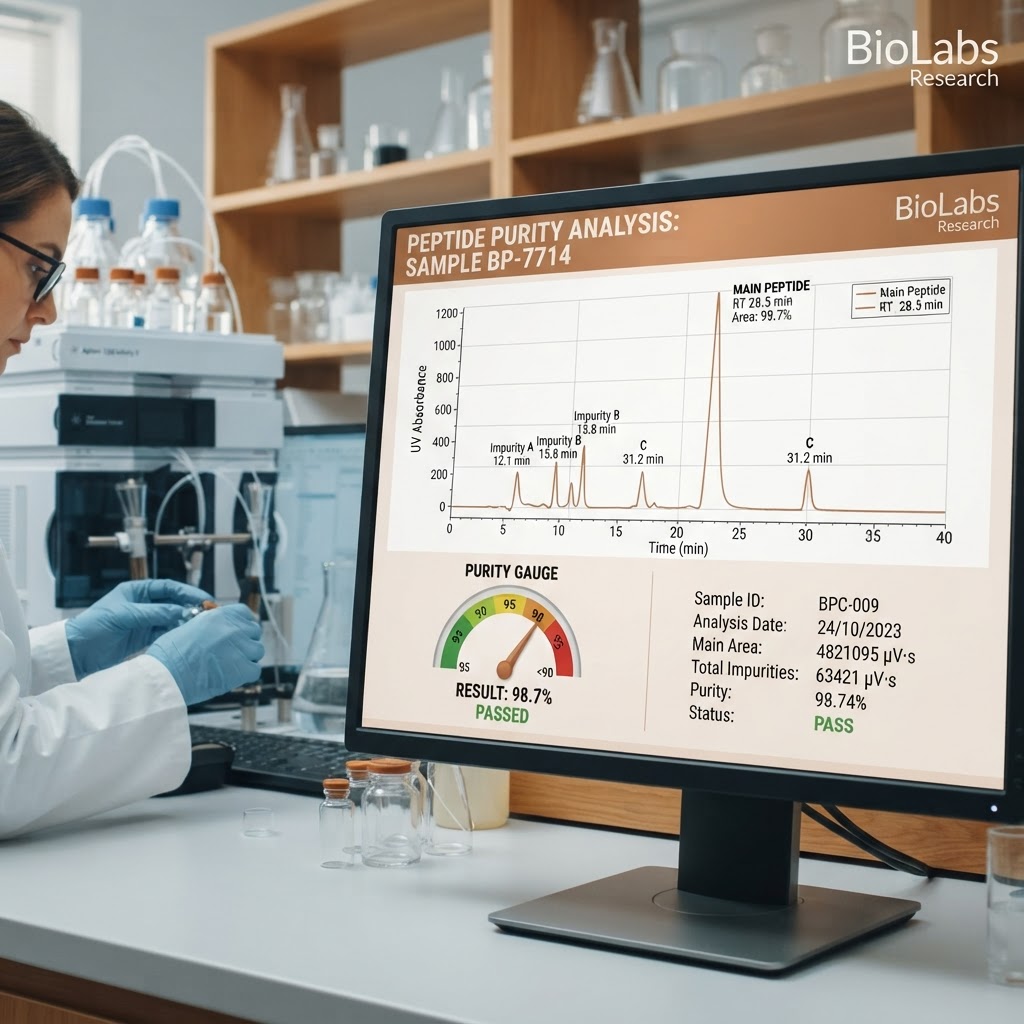
Reading an HPLC chromatogram: the main peak area vs. impurity peaks determines p

Documentation matters: a COA is only as reliable as the researcher who reads it
A Certificate of Analysis (COA) is the single most important document when sourcing research peptides. It tells you what's in the vial, how pure it is, and whether the identity matches the label. This guide walks through each section of a typical peptide COA and explains what to look for — and what red flags to avoid.
Why COA Quality Matters
Not all COAs are created equal. A COA is only as strong as the laboratory name, testing method, and lot ID printed on it. Without these elements, a COA is just a piece of paper. Researchers sourcing peptides for in vitro studies should verify that:
- The testing laboratory is named and identifiable
- The testing method is specified (e.g., HPLC at 214 nm)
- The lot number matches the vial label
- The purity percentage is stated with the measurement method
HPLC Purity Analysis
High-Performance Liquid Chromatography (HPLC) is the gold standard for peptide purity analysis. The COA should report:
- Purity percentage — reported on the lot COA (HPLC/MS); no catalog-wide guarantee
- Detection wavelength — 214 nm is standard for peptide detection; 220 nm is also used
- Chromatogram — a visual trace showing the main peak and any impurities
- Integration method — area percent is most common for purity reporting
A single sharp peak at the expected retention time indicates high purity. Multiple significant peaks suggest impurities or incomplete synthesis.
Mass Spectrometry (MS) Confirmation
Mass spectrometry confirms the molecular identity of the peptide. The COA should include:
- Molecular weight — the observed mass should match the theoretical mass within instrument tolerance
- Spectrum trace — showing the molecular ion peak
- Ionization method — typically ESI (electrospray ionization) or MALDI
MS data is critical because HPLC alone cannot distinguish between peptides of similar retention times but different molecular weights.
Residual Solvent Testing
Peptide synthesis involves organic solvents (acetonitrile, TFA, etc.). A quality COA should report residual solvent levels, particularly:
- Trifluoroacetic acid (TFA) — common counter-ion in peptide synthesis; residual levels should be documented
- Acetonitrile — the primary HPLC solvent; residual levels should be below specified limits
- Water content — Karl Fischer titration or equivalent
High residual solvent levels can interfere with sensitive in vitro assays.
Endotoxin Testing
For cell culture applications, endotoxin levels matter. Bacterial endotoxin can trigger immune responses in cell-based assays, confounding results. A quality peptide COA may include:
- Endotoxin level — typically reported in EU/mg (endotoxin units per milligram)
- Test method — LAL (Limulus Amebocyte Lysate) assay is standard
For cell culture work, endotoxin levels below 0.5 EU/mg are generally preferred.
Red Flags in Peptide COAs
Watch for these warning signs when evaluating a peptide supplier's documentation:
- No laboratory name — if the testing lab isn't identified, the COA has limited value
- No lot number — without lot traceability, you can't verify which batch was tested
- No method specified — a purity number without stating how it was measured is meaningless
- Template-only COAs — identical COAs for every lot suggest template rather than actual testing
- Missing dates — no manufacture or test date raises traceability concerns
Requesting a COA Before Purchase
It is standard practice in reagent sourcing to request a COA before purchase. A reputable supplier will either provide the COA on their website or send it on request. At BioLabs Research, we provide lot COAs on request when available. Contact us at inquiry form with the product name and lot number.
Quality is never an accident; it is always the result of intelligent effort.
Need a COA for Your Research?
Lot documentation available on request. Third-party tested.
Read Our Full COA Guide →Checklist: What to Verify on a Peptide COA
- ☐ Laboratory name is identified
- ☐ Lot number matches the vial label
- ☐ HPLC purity (area%) with wavelength specified on the lot COA — no catalog-wide %
- ☐ Mass spec confirms molecular weight
- ☐ Residual solvent levels reported
- ☐ Endotoxin level stated (for cell culture use)
- ☐ Manufacture date or test date included
- ☐ Testing method clearly specified