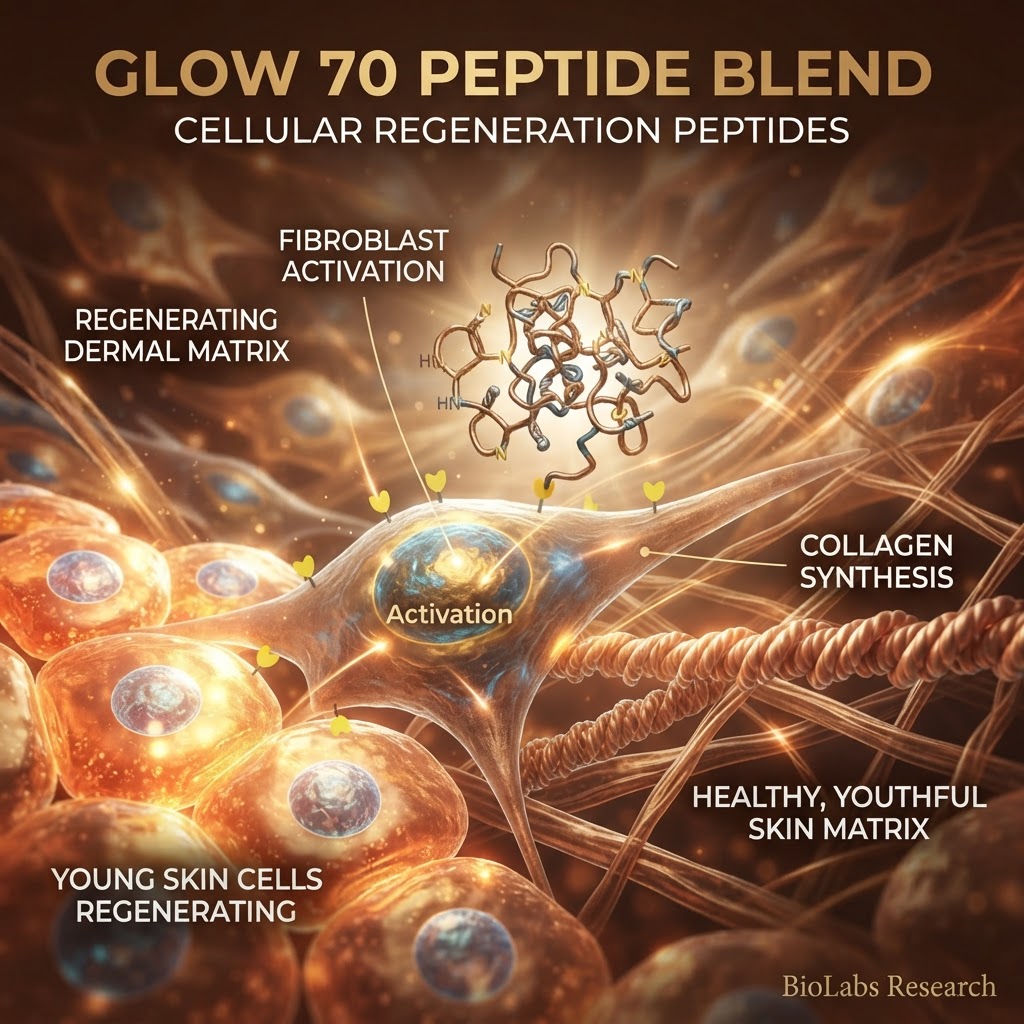
GLOW 70 blend: a proprietary peptide formulation targeting fibroblast activation
GLOW 70 is a named catalog blend. It is not a CAS number. A trade name on a vial does not mint a registry substance. Until a lot certificate of analysis lists the component molecules — names, sequences or formulas, and masses — the listing is a name. This article will not invent those components.
The live product page for GLOW 70 on this site does not publish component peptides. That silence is the identity story. Other blend SKUs on the same catalog do name both molecules. Those are different listings. Do not copy their recipes onto this one.
Trade-name blends do not get a CAS
CAS registry numbers index defined substances. A house blend name — GLOW, a number, a marketing token — is not a defined substance. Assigning a fake CAS to a trade name, or borrowing a CAS from a peptide that might be in some other shop's glow mix, is a labeling failure. The correct CAS line for an unnamed blend is: none, pending the component list.
| Listing type | What identity looks like | CAS |
|---|---|---|
| Single peptide (example: KPV) | One sequence, one mass, one public CAS | Yes — the molecule's CAS |
| Named two-molecule blend | Two sequences, two masses, both printed on the PDP | Two CAS numbers; no third CAS |
| Trade-name blend (GLOW 70) | Name on the carton; components only if the lot COA lists them | No CAS for the name |
If a vendor prints a single CAS on a GLOW 70 label, ask which molecule that CAS belongs to, and where the other components are. If they cannot answer, you do not have identity.
Identity is the lot COA component list
For a named blend, the only document that can turn a name into chemistry is a lot COA that lists each component: name, sequence or formula, theoretical mass, observed mass, and — if the work is quantitative — how much of each is in the cake. HPLC area% of the blend peak is not that list. A storefront graphic is not that list. A blog article is not that list, including this one.
Until that paper exists, a receiving lab should log GLOW 70 as a named SKU with identity pending, not as a sequence. Do not write a methods section that pretends the vial is a known peptide. Do not copy a competitor's glow recipe into your notebook and call it this catalog's lot.
Contrast with blends that name both molecules
This catalog has blend SKUs that do the honest thing and print both chemicals:
- BPC-157 / TB-500 blend — two sequences, two masses. Identity note: two sequences, two masses.
- Tesamorelin / ipamorelin — two CAS numbers on one vial. Identity note: two CAS numbers.
Those pages can be checked against public registries before the lot arrives. GLOW 70 cannot, because the live PDP does not publish the components. That is not a gap this article will fill with a guess.
What this article will not invent
It is common, on other storefronts, to see GLOW used as shorthand for a GHK-Cu plus BPC-157 plus TB-500 mix, or some other trio. This article does not assert that mix for biolabsresearch.co. It does not assert any other mix. The live PDP does not publish component peptides. Inventing GHK-Cu + BPC-157 + TB-500 (or any other recipe) would be a false identity statement.
If a future lot COA names components, those names belong to that lot. They still do not become a CAS for the trade name. Another lot could differ. File COAs by lot number, not by the word GLOW.
Request the COA
The practical action is to request the lot certificate of analysis and to refuse to treat the SKU as a defined mixture until the component list is on paper. The catalog page is GLOW 70. Ask for lot number, component names, sequences or formulas, observed masses, and the HPLC method. If the reply is a brand story without those lines, you still have a name, not a chemical identity.
Related lab notes: HPLC area% vs net peptide content and How a Serious Lot Is Read. Those pages explain why a UV percentage cannot substitute for a component list.
What belongs in a purchasing file
Record the SKU name, the URL of the live PDP, the date you checked that the PDP still does not list components, and the COA request. If a COA later arrives, file it under the lot number and quote its component table verbatim. Do not back-propagate that table onto older lots. Do not print it on this blog as if it were the definition of GLOW 70.
Beauty begins the moment you decide to be yourself. — Coco Chanel
GLOW 70 listing
A named catalog blend, not a CAS. Research use only. Identity is the lot COA component list. Request that paper. This article does not invent a mix.
View GLOW 70 →References
- No CAS and no component DOI are published for this trade-name listing. Identity is deferred to the lot COA. Do not cite a guessed recipe. Live PDP: https://biolabsresearch.co/products/glow-70
- Contrast, named two-molecule blends on this catalog: BPC-157 / TB-500 blend and tesamorelin / ipamorelin.