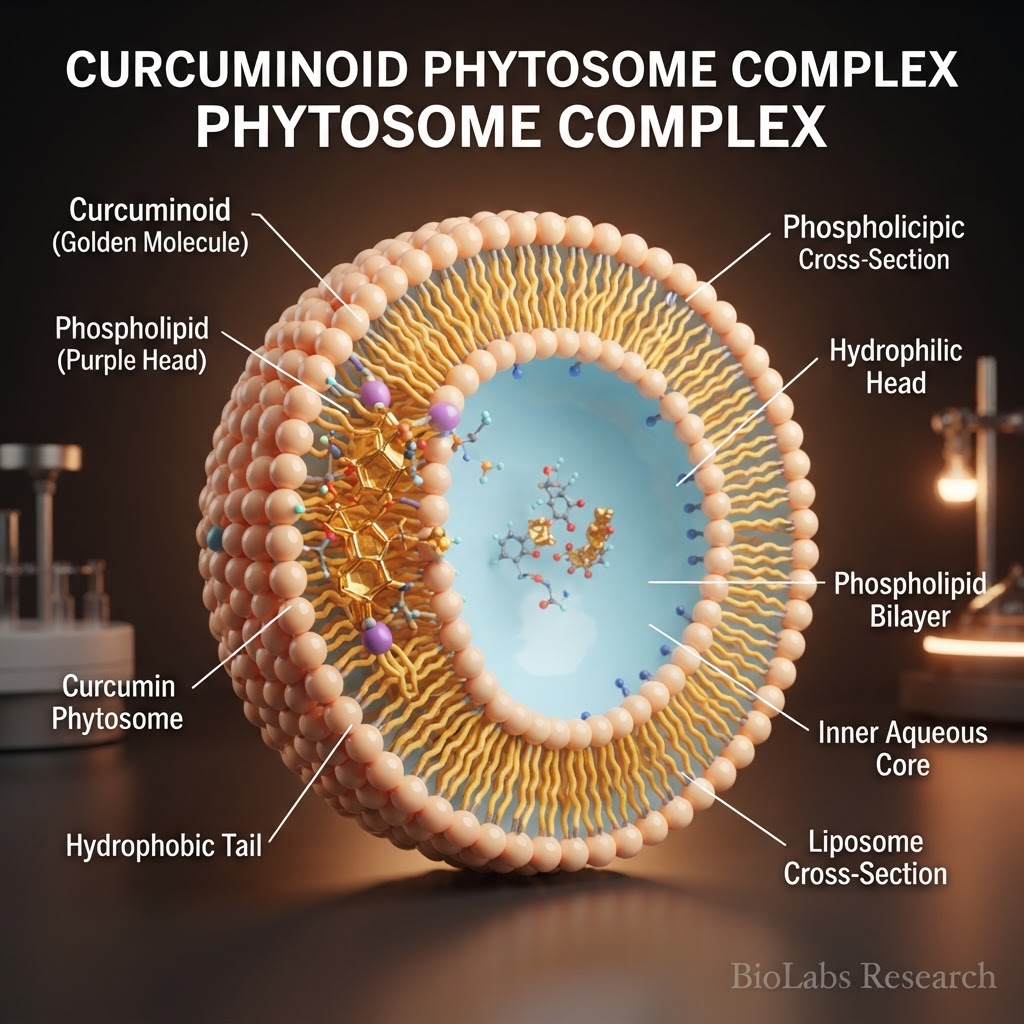
Phytosome structure: curcuminoid complexed with phosphatidylcholine — the lipid-
Curcumin phytosome is not a peptide and it does not have a peptide CAS. Curcumin itself is diferuloylmethane, a diarylheptanoid polyphenol. A phytosome, in the formulation sense used on this listing, is that curcuminoid material associated with phosphatidylcholine (lecithin). The catalog line is a complex, not a 15-mer, not a 28-mer, and not a third registry number invented for a brand name.
This note is formulation identity for laboratory purchasing. It is not an osteoarthritis product, not a human-dose table, and not a claim that the vial is licensed Indena material. Meriva is an Indena trademark. Using that word as a catalog synonym does not transfer a license, a composition specification, or a clinical brand.
Curcumin (diferuloylmethane) identity
PubChem indexes curcumin as CID 969516. The formula is C21H20O6, molecular weight 368.4 g/mol, CAS 458-37-7.1 That CAS is the small molecule. It is not a CAS for a phospholipid complex, and it is not a CAS for a peptide.
| Field | Curcumin (small molecule) |
|---|---|
| Name | Curcumin; diferuloylmethane |
| CAS | 458-37-7 |
| PubChem CID | 969516 |
| Formula | C21H20O6 |
| MW | 368.4 g/mol |
Technical curcuminoid mixtures also contain demethoxycurcumin and bisdemethoxycurcumin. Those are different formulas. A COA that only says “curcumin 95%” without saying which HPLC method and which curcuminoid set has not finished identity. We will not invent a curcuminoid percentage for this SKU.
What a phytosome is
In the formulation literature, a phytosome (or phospholipid complex) pairs polyphenols with phosphatidylcholine. The listing is therefore at least two material classes: curcuminoids and phospholipid. There is no single peptide CAS that describes that pair. Printing CAS 458-37-7 on a phytosome vial names the curcuminoid, not the complex. Printing a peptide CAS on this SKU is a category error.
What to put on a receiving log:
- Curcumin / curcuminoids: CAS 458-37-7 as the small-molecule index, plus which curcuminoid set the lot actually contains.
- Phospholipid: phosphatidylcholine or lecithin identified as a material, not as a peptide.
- No third CAS invented for the catalog name.
If the lot is a physical mixture versus a described complex, the COA should say which. This article will not guess the process.
Meriva is a trademark, not a license claim
The catalog name on this site uses Meriva. Meriva is an Indena trademark for a curcumin-phospholipid formulation. This RUO listing does not claim to be licensed Indena material, does not claim Meriva as a composition standard we have been granted, and does not claim bioequivalence to any branded clinical product. Trademark-as-SKU is a naming problem. Treat it as a catalog name and demand the lot’s own chemistry.
If a purchase order needs Indena-sourced Meriva, buy Indena-sourced Meriva through a channel that can show that chain. If the PO needs a research curcuminoid-phospholipid material, match the lot COA, not the trademark string.
Cuomo 2011: formulation identity, not a disease claim
Cuomo and colleagues compared absorption of a standardized curcuminoid mixture and its lecithin formulation in Journal of Natural Products in 2011.2 The paper is cited here as formulation identity: lecithin (phosphatidylcholine) association is a real, published way to describe this class of material. It is not cited as osteoarthritis evidence, not as a human dose, and not as a reason this catalog exists. BioLabs Research does not sell curcumin phytosome as a joint product or a dietary supplement.
What to ask the lot COA for
Because this is not a peptide, the usual peptide trio (sequence, intact MS, HPLC area%) is the wrong template. Ask for:
- Curcuminoid content as a measured percent, with method (HPLC wavelength and which peaks were integrated).
- Which curcuminoids were reported (curcumin vs total curcuminoids).
- Phospholipid / phosphatidylcholine identity and, if measured, its fraction.
- Lot number matching the container. Testing lab named.
We will not invent those percentages. If the paper does not exist, the honest line is COA on request. Residual solvents and heavy metals, when relevant to a botanical-derived lot, are separate assays — still lot data, still not a blog number.
Related reading: HPLC area% vs net peptide content (for why a UV ratio is not a mass of analyte) and How a Serious Lot Is Read.
Nature itself is the best physician. — Hippocrates
Curcumin phytosome listing
Research-use-only complex: curcuminoids plus phosphatidylcholine. Not a peptide CAS. Not a claim of licensed Indena Meriva. Lot COA on request.
View curcumin phytosome →References
- National Center for Biotechnology Information. PubChem Compound Summary for CID 969516, Curcumin. Formula C21H20O6; MW 368.4 g/mol; CAS 458-37-7. https://pubchem.ncbi.nlm.nih.gov/compound/969516
- Cuomo J, Appendino G, Dern AS, et al. Comparative absorption of a standardized curcuminoid mixture and its lecithin formulation. J Nat Prod. 2011;74(4):664-669. Cited for formulation identity (lecithin association), not as osteoarthritis selling and not as a human dose. https://doi.org/10.1021/np1007262